
The manufacturing sector is rapidly embracing artificial intelligence to boost productivity, safety, and quality. Among the most transformative technologies is the YOLO model for real-time object detection, which empowers factories to identify products, defects, and safety hazards instantly on the production line. This approach is reshaping how industrial environments monitor processes, automate inspections, and ensure compliance with stringent standards.
By leveraging deep learning and computer vision, YOLO (You Only Look Once) enables machines to analyze images and video feeds with remarkable speed and accuracy. As factories strive for higher efficiency and lower error rates, integrating such advanced vision systems is becoming a competitive necessity. For those interested in the broader landscape of AI-driven inspection, exploring topics like augmented reality in quality audits can provide additional context on how digital tools are transforming quality assurance.

Understanding YOLO and Its Industrial Impact
YOLO stands for “You Only Look Once,” a deep learning framework designed for rapid and accurate object identification in images and videos. Unlike traditional methods that scan an image multiple times, YOLO processes the entire frame in a single pass, making it exceptionally fast. This characteristic is crucial for real-time object detection in factory settings, where delays can disrupt workflows or compromise safety.
The model divides an image into a grid and predicts bounding boxes and class probabilities for each section. This allows the system to detect multiple objects simultaneously, even in complex industrial scenes with overlapping items or moving machinery. Its ability to deliver both speed and precision makes it ideal for applications such as:
- Automated quality inspection
- Counting products on conveyor belts
- Detecting foreign objects or defects
- Monitoring worker safety and compliance
Key Advantages of YOLO-Based Detection in Manufacturing
Integrating a YOLO model for real-time object detection into factory operations brings several significant benefits:
- Speed: YOLO’s architecture enables near-instantaneous analysis, supporting high-throughput production lines without bottlenecks.
- Accuracy: The model’s deep learning backbone can be trained to recognize a wide variety of objects, including subtle defects or rare anomalies.
- Scalability: YOLO can be deployed on edge devices, local servers, or in the cloud, making it suitable for factories of all sizes.
- Versatility: It can be adapted for different tasks, from product counting to safety monitoring, simply by retraining with new datasets.
These strengths make YOLO a preferred choice for manufacturers aiming to automate inspection and reduce human error. When compared to older vision systems, YOLO’s ability to process live video streams and provide actionable insights in real time is a game-changer.
How YOLO Works in a Factory Environment
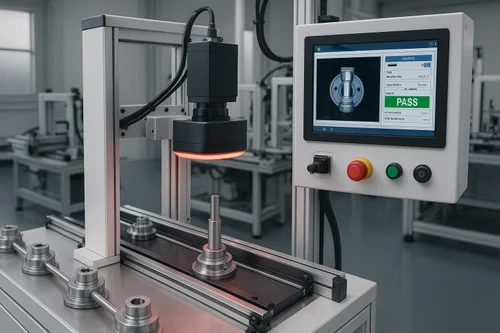
Deploying YOLO in industrial settings typically involves integrating cameras along production lines or workstations. The video feeds are processed by the YOLO algorithm, which identifies and classifies objects frame by frame. Detected items are highlighted with bounding boxes, and the system can trigger alerts or actions based on predefined rules.
For example, if a defective product is detected, the system can automatically divert it from the main line. If a worker enters a restricted area, an alert can be sent to supervisors. The flexibility of YOLO allows it to be tailored for a wide range of use cases, including:
- Packaging verification
- Component assembly checks
- Foreign object detection in food processing
- Monitoring of personal protective equipment (PPE) compliance
The model’s performance can be further enhanced by combining it with other AI technologies. For instance, integrating YOLO with vision transformers for industrial use can improve detection accuracy for complex or irregular objects.
Challenges and Considerations for Implementation
While YOLO offers impressive capabilities, successful deployment in factories requires careful planning. Some of the main considerations include:
- Data Quality: Training the model demands a large, diverse dataset of labeled images relevant to the specific factory environment.
- Lighting and Camera Placement: Variations in lighting or poorly positioned cameras can affect detection accuracy.
- Hardware Requirements: Real-time processing may require powerful GPUs or optimized edge devices, especially for high-resolution video streams.
- Continuous Monitoring: Over time, changes in products or processes can cause the model to drift, requiring periodic retraining or adjustment. For more on this, see insights on monitoring AI model drift in factories.
Addressing these factors ensures that the benefits of YOLO are fully realized and that the system remains robust as factory conditions evolve.
Best Practices for Deploying YOLO in Industrial Settings
To maximize the value of real-time object detection with YOLO, manufacturers should follow several best practices:
- Start with a Pilot: Test the system on a single line or process to evaluate performance and identify potential issues.
- Use High-Quality Training Data: Collect images under various conditions to improve the model’s robustness.
- Optimize Model Parameters: Fine-tune hyperparameters for the specific application. For guidance, refer to resources on hyperparameter tuning for inspection models.
- Integrate with Factory Systems: Connect YOLO outputs to existing MES, ERP, or quality management systems for seamless automation.
- Monitor and Update Regularly: Continuously assess model performance and retrain as needed to adapt to new products or changes in the environment.
Following these steps helps ensure a smooth transition to AI-driven inspection and monitoring, minimizing disruption and maximizing ROI.
Real-World Applications and Industry Benefits
Factories across sectors are already seeing tangible improvements by adopting YOLO-based vision systems. In packaging, for example, the technology is used to verify label placement, detect damaged goods, and count items in real time. In automotive assembly, it helps ensure that all components are present and correctly installed, reducing the risk of costly recalls.
The food and beverage industry leverages YOLO to spot contaminants or foreign objects, enhancing safety and compliance. For more on the broader advantages of AI in inspection, see this overview of AI’s benefits in quality control and inspection.
These examples highlight how YOLO-powered object detection is not just a theoretical innovation but a practical tool delivering measurable results in diverse manufacturing environments.
Integrating YOLO with Other AI Tools
The effectiveness of YOLO can be further enhanced by combining it with complementary AI technologies. For instance, wearable devices equipped with AI can assist manual inspectors, as discussed in the context of wearable AI for manual inspection support. Additionally, augmented reality overlays can provide real-time feedback to workers, improving both accuracy and efficiency.
By building an ecosystem of interconnected AI tools, factories can achieve higher levels of automation, reduce downtime, and respond more quickly to quality or safety issues.
Frequently Asked Questions
What makes YOLO suitable for real-time object detection in factories?
YOLO’s architecture processes entire images in a single pass, enabling it to detect multiple objects at high speed. This efficiency is essential for fast-moving production lines where immediate feedback is required to maintain quality and safety.
How does YOLO compare to other object detection models in industrial use?
While models like SSD and Faster R-CNN offer strong detection capabilities, YOLO is often preferred in manufacturing due to its superior processing speed and ability to handle real-time video streams. Its balance of speed and accuracy makes it ideal for dynamic environments.
Can YOLO be customized for specific factory tasks?
Yes, YOLO can be retrained with custom datasets to recognize unique products, defects, or safety gear relevant to a particular factory. This adaptability ensures that the system remains effective as production needs change.